Preface
I came to this book on a recommendation from the colleague I was closest to at my first job in Korea. That place, that job, had something strange about it. It had the freedom characteristic of an IT company and at the same time no small amount of hierarchical old-guard culture, such as enforcing honorific conventions. On top of that, several colleagues came from different countries, and even among those who shared a nationality the differences in background and culture stood out sharply.
Ideally, I think, a conversation is people exchanging differing opinions from a roughly shared understanding of the situation at hand. In that place even that obvious premise was hard to establish. Whatever subject a conversation started from, the angle on the situation, the attitude with which it was received, and the underlying assumptions were all so different that we usually careened toward some irrelevant conclusion, or the conversation ended awkwardly with each side merely hungry for the other’s sympathy.
Perhaps for that reason, finding a like-minded colleague there was not easy, and the person who introduced me to this book was the only one. We were on different teams, so unfortunately we never got to exchange anything technical, but he was a good elder in life to me. Talking with him taught me a great deal about how to approach living. At the time he was carrying the fear that he might lose a family member, and he said this book had given him comfort. More precisely, it seemed to have helped him prepare for a “scheduled grief” that was not far off.
Overall
I am not especially fond of books built as a sequence of anecdotes. One reason is that conveying a lesson through an anecdote takes a lot of supporting explanation to walk the reader to that lesson; another is that it is hard to relate to every anecdote you are given, and once you cannot, you lose interest and start skipping. Still, I take some value in there being anecdotes I could relate to and in the room they gave me to think. There was a passage to the effect that once you have resolved to accept pain you can endure having a healthy tooth pulled out with pliers — and there was a lot of that sort of demand for deep practice.
Even so, there were plenty of places that struck a chord here and there, and for that much alone I think the book was worth reading.
Notes
Two bricks
The meaning of two badly laid bricks among a thousand: people fixate on the two that are wrong and attach little significance to the 998 that were laid well. And it expands into the idea that perhaps what makes each person distinctive comes out of exactly such small mistakes. Depending on where you place your focus, the same small mistake can be something you cannot let go of, or the particular thing that makes you yourself.
Everything you have done so far is complete in itself. … It is the only true way to rest your thoughts. Otherwise the affairs of the human world will never end.
It is presented as an attitude of being satisfied with the present and stopping your thoughts, but it made me reflect on my own habit of always clinging to “finishing”. With my resignation approaching, I intend to at least see the work currently in flight through to the end — and it occurred to me that I am packaging that in the plausible, socially approved word “responsibility” to persuade myself. As the book says, it is in fact sufficiently finished even if I let go now. What is not finished is my own uneasy mind.
… you decide you will enjoy a brief peaceful moment in the garden once you have cleared the trivial tasks. … Those tasks never end, and so the chance to “enjoy a brief peaceful moment” never comes. … The only people “resting in peace” are those in graves.
I am always waiting for a peaceful moment to arrive — a time in which I will rest, or genuinely immerse myself in what I want to do. Honestly, I have never once properly had such a moment. There is always some trivial task. A phone call comes, some housework appears, and it always ends in complaint. I feel that such a perfect moment does not come to you; it is something you have to go and find.
Letting go
What we ought to let go of is precisely the mind that wants to let go.
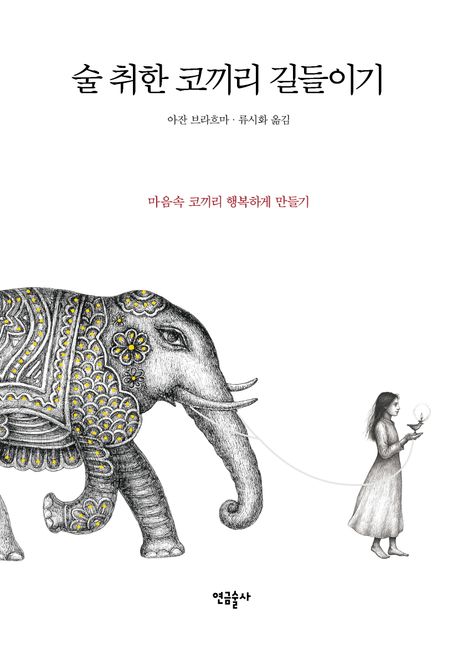
Taming the drunken elephant
The trouble is that when we get angry, we enjoy our anger. Anger is addictive and carries a strange pleasure. And we human beings do not easily discard what gives us pleasure.
The biggest thing in the world
To judge absolutely — to insist that “this is the truth and everything else is not” — is not wisdom.
I generally try to avoid thinking that I “know” something. If it is a matter of fact, what I know is only what I have chosen to believe out of what I observed or was told; if it is a matter of a discipline, I do not know the whole of that discipline but have studied only a sliver of it. I liked this sentence because it seems to support that view.
There is a side effect, though: I stop revealing my judgements in front of others, and I inwardly criticise people who reveal theirs too readily.